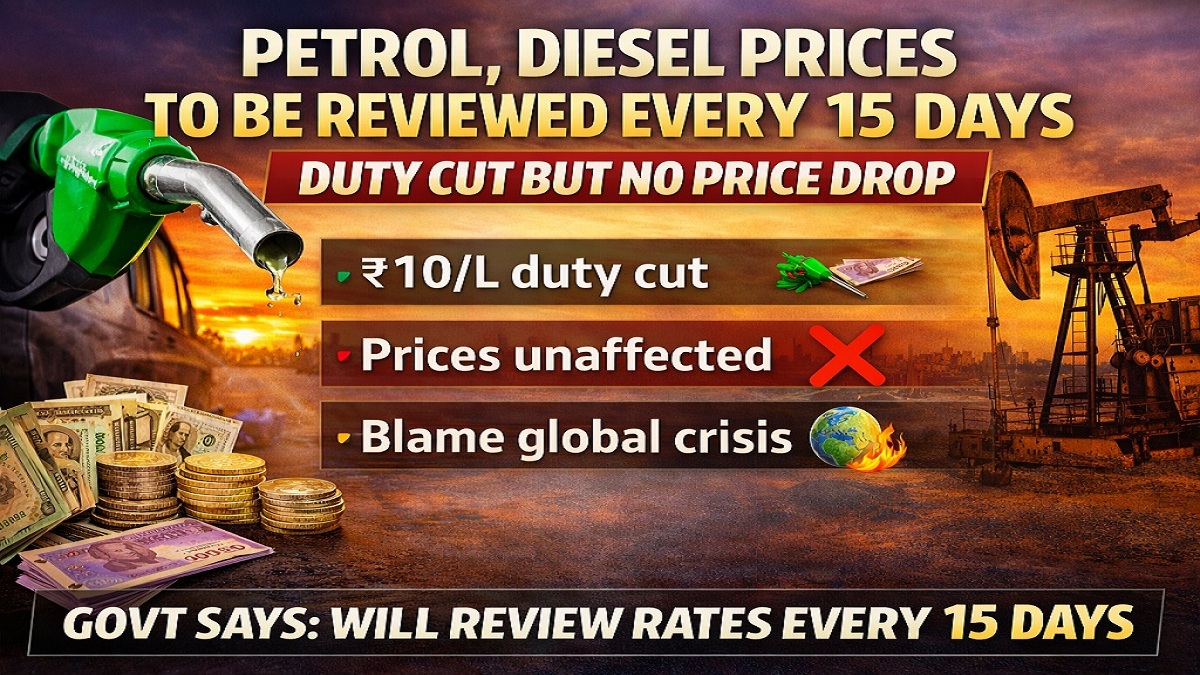
The government has made a big announcement on fuel pricing – but if you were hoping for cheaper petrol or diesel right away, that relief isn’t coming just yet.
On Friday, the Centre said that petrol diesel prices will now be reviewed every 15 days, a move aimed at keeping pace with the fast-changing global oil market. This comes just after the government cut excise duty by ₹10 per litre on both fuels.
Duty Cut Announced – But Prices Stay the Same
Even though the government has reduced taxes, petrol diesel prices at the pump are unlikely to drop immediately.
After the latest revision:
- Petrol excise duty is now ₹11.9 per litre
- Diesel excise duty stands at ₹7.8 per litre
But officials have made it clear — this cut is not meant to directly benefit consumers right now.
Instead, it’s aimed at helping oil companies manage rising costs.
Why Aren’t Prices Going Down?
That’s the big question everyone is asking.
According to officials, oil companies have been under pressure due to the sudden surge in global crude oil prices. In many cases, they’ve been selling fuel at a loss or with very thin margins.
So, the government stepped in to ease that burden, not to immediately lower retail prices.
In simple terms:
The relief is going to oil companies first, not your fuel bill — at least for now.
What’s Causing This Situation?
The answer lies in global politics.
The ongoing conflict involving the US, Israel, and Iran has shaken energy markets. On top of that, Iran’s blockade of the Strait of Hormuz – one of the world’s busiest oil routes – has made things even more uncertain.
To give you an idea of how serious this is:
- Crude oil was around $68 per barrel before the conflict
- It crossed $100 within days
- Now, it’s hovering around $110 per barrel
That kind of spike puts pressure on fuel prices everywhere, including India.
Why India Is Feeling the Impact
India imports a large chunk of its oil, and a big part of that supply passes through the Strait of Hormuz.
- Nearly half of India’s crude oil imports come through this route
- A significant share of LPG and natural gas also depends on it
So when there’s disruption there, it directly affects India’s energy security and costs.
Should You Worry About Shortages?
For now, the government says there’s no need to panic.
Officials have assured that:
- India has about 60 days’ worth of crude oil reserves
- LPG supply is stable
- Refineries are running at full capacity (even above 100%)
They’ve also dismissed rumours of shortages as misleading and unnecessary.
What Does a 15-Day Review Mean for You?
This is actually an important shift.
Instead of unpredictable changes, fuel prices may now be adjusted more regularly and gradually. That could mean:
- Fewer sudden shocks
- Faster response to global changes
- More transparency in pricing
But it also means prices could go up or down more frequently, depending on what’s happening globally.
The Bottom Line
The government’s move shows it’s trying to balance a tricky situation — rising global oil prices on one hand, and consumer pressure on the other.
For now, don’t expect an immediate drop in petrol diesel prices. But with regular reviews every 15 days, things could change quickly depending on how the global situation unfolds.
ALSO READ : Indian LPG Carrier Shivalik Crosses Strait of Hormuz