


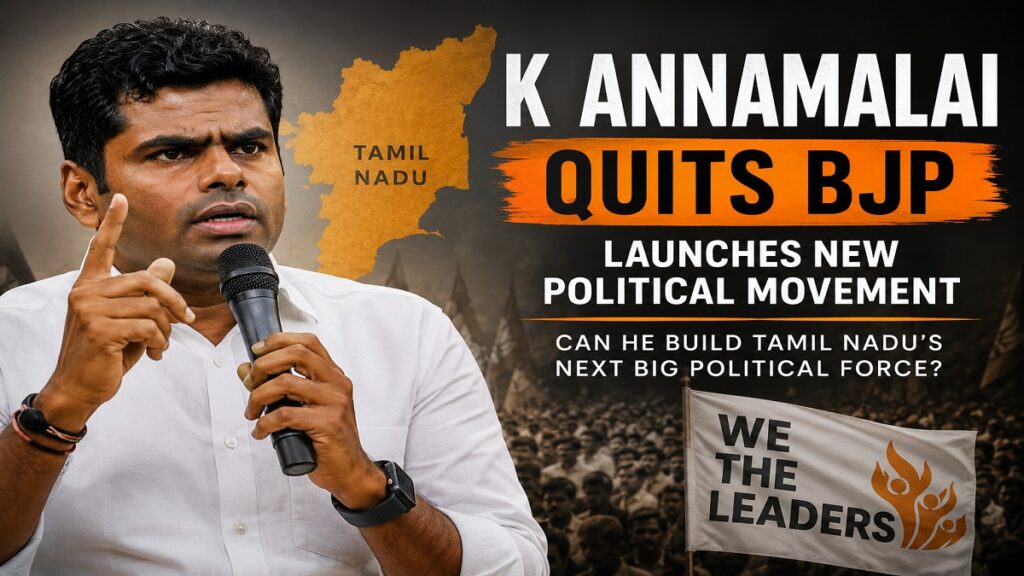
K Annamalai Quits BJP, Launches New Political Movement: Can Tamil Nadu’s Rising Star Build a Third Alternative?
Chennai: Former Tamil Nadu BJP president and ex-IPS officer K Annamalai has finally taken the political step that had been generating intense speculation for weeks. In a move that could reshape the state’s political landscape, Annamalai has officially quit the BJP and expanded his existing “We The Leaders” platform into a broader political movement, setting the stage for the launch of a new political party in the coming years.
The development marks a major turning point in Tamil Nadu politics, where K Annamalai emerged as one of the most recognizable faces of the BJP over the past few years. While his departure has surprised some observers, many political analysts had anticipated that the former police officer might eventually chart an independent course.
As the movement begins to take shape, the key question remains: Can K Annamalai transform personal popularity into lasting political success?
A Rapid Rise in Tamil Nadu Politics
Few politicians in Tamil Nadu have experienced a rise as swift as Annamalai’s.
Inspired by Prime Minister Narendra Modi’s leadership style, K Annamalai resigned from the Indian Police Service and joined the BJP in 2020. Within a year, he was appointed as the party’s state president, becoming one of the youngest leaders to hold the position.
Known for his strong communication skills, aggressive campaigning, and active social media presence, K Annamalai succeeded in bringing the BJP into mainstream political discussions in a state traditionally dominated by the DMK and AIADMK.
Even political rivals acknowledge that Annamalai’s personal popularity often exceeds the BJP’s electoral strength in Tamil Nadu.
Asset No. 1: Strong Personal Connect With Voters
One of Annamalai’s biggest strengths is his individual appeal.
Unlike many leaders who rely heavily on party structures, he has built a loyal following through public outreach programs, grassroots campaigns, and direct engagement with voters.
His image as a former police officer who left a secure career to enter public life has resonated with many young voters and professionals.
This personal brand could become the foundation of his new political venture.
Asset No. 2: Freedom From BJP’s Political Limitations
Ironically, leaving the BJP may provide Annamalai with greater political flexibility.
While he enjoyed popularity as a leader, the BJP continues to face resistance among sections of Tamil Nadu’s electorate. Many voters who admired Annamalai personally were hesitant to support the party.
By launching an independent movement, he may now be able to attract voters who were previously unwilling to back him because of his association with the BJP.
Political observers believe this could significantly expand his potential support base.
Asset No. 3: A Changing Political Environment
The timing of K Annamalai’s move may prove advantageous.
Tamil Nadu is currently witnessing one of its most significant political transitions in decades. The emergence of actor-turned-politician Vijay and his party, TVK, has demonstrated that voters are increasingly open to new political alternatives.
At the same time, the traditional dominance of the DMK and AIADMK is being challenged by changing voter expectations and leadership transitions.
This evolving political environment creates space for new movements and fresh political narratives.
Asset No. 4: Potential to Build New Alliances
Unlike traditional parties that often revolve around a single leader, Annamalai appears to be promoting a leadership-sharing model.
Through his “We The Leaders” platform, he has emphasized creating opportunities for emerging leaders rather than concentrating power at the top.
Political experts believe this approach could attract ambitious second-rung leaders from existing parties who see limited opportunities for advancement within established structures.
If executed effectively, it could help him build a coalition of smaller parties, community leaders, and young political aspirants.
Asset No. 5: Building an Organisation Before Launching a Party
One notable aspect of K Annamalai’s strategy is his focus on organization-building before formally launching a political party.
Through the We The Leaders platform, volunteers can register, receive training, and potentially develop into local-level leaders. The movement aims to identify future candidates and prepare them for local body and assembly elections.
This model resembles the grassroots network-building approach that helped several successful regional parties establish themselves over time.
If the organizational structure develops as planned, it could provide a stronger foundation than personality-driven political projects.
The Challenges Ahead
Despite the opportunities, Annamalai’s political journey is far from guaranteed.
Several major challenges could determine whether his movement succeeds or fades away.
Liability No. 1: Limited Electoral Success So Far
The most significant criticism of Annamalai remains his electoral track record.
Although he increased the BJP’s visibility and strengthened its presence in public discourse, the party failed to achieve major breakthroughs in recent elections under his leadership.
Supporters argue that he expanded the party’s vote share and political relevance. Critics counter that popularity must eventually translate into electoral victories.
The success of his new movement will ultimately be judged at the ballot box.
Liability No. 2: The BJP Connection May Persist
Even after leaving the BJP, Annamalai may find it difficult to escape his past association with the party.
Political opponents have already begun portraying his new initiative as an extension of the BJP’s broader strategy in Tamil Nadu.
Such allegations could make it difficult for him to attract voters who remain strongly opposed to the BJP while also risking confusion about the movement’s political identity.
Liability No. 3: Lack of a Clearly Defined Ideology
Another challenge is the absence of a clear ideological framework.
While Annamalai has spoken extensively about leadership, ethics, governance, and political reform, he has yet to outline a detailed policy agenda or ideological vision.
Political movements often require a strong identity to sustain long-term growth. Voters will eventually expect clear positions on economic development, social welfare, education, federalism, and other key issues.
Without a defined ideology, sustaining momentum may become difficult.
Liability No. 4: The Difficulty of Building a Party From Scratch
Tamil Nadu’s political history offers several examples of charismatic leaders who struggled to convert public popularity into a durable political organization.
Building a successful party requires more than crowd-pulling ability. It demands district-level networks, local leadership, funding mechanisms, booth-level workers, and sustained grassroots engagement.
Creating such a structure across Tamil Nadu will be one of Annamalai’s toughest tests.
The Road Ahead
K Annamalai’s departure from the BJP marks the beginning of a new chapter in Tamil Nadu politics. His popularity, communication skills, and organizational ambitions give him several advantages that many new political entrants lack.
Get latest news and updates in India and around the world on First News Time.