


EC Expands SIR Drive Across 16 States and 3 UTs, Opposition Raises Questions
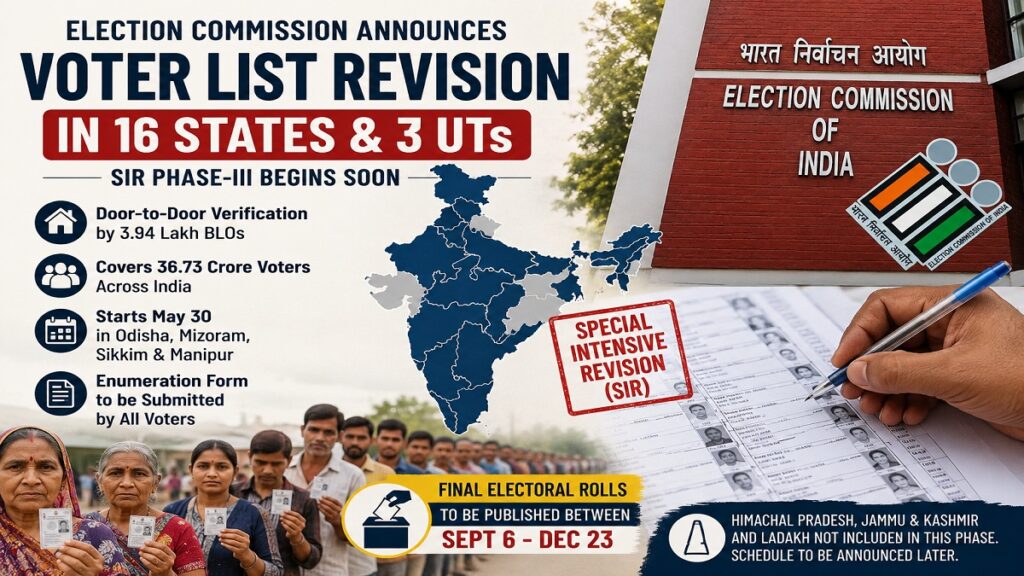
The Election Commission of India (ECI) has announced the third phase of its Special Intensive Revision (SIR) of electoral rolls, taking the massive voter verification exercise to 16 states and three Union Territories in the coming months.
The move is being seen as one of the biggest electoral roll revision drives in recent years, with lakhs of officials expected to visit homes across the country to verify voter details. While the EC says the exercise is necessary to clean up electoral rolls and remove duplicate or outdated entries, the process has already sparked political debate and legal challenges.
Notably, Himachal Pradesh, Jammu and Kashmir, and Ladakh have not been included in this phase. The Election Commission said the schedule for these regions will be announced later due to ongoing Census work and weather conditions in snow-bound areas.
House-to-House Verification to Begin from May 30
The third phase of the SIR exercise will begin on May 30 in Odisha, Mizoram, Sikkim, and Manipur. Booth Level Officers (BLOs) will start visiting homes to collect voter information and enumeration forms.
The revision drive will then expand to other states and Union Territories in phases:
- June 4: Dadra and Nagar Haveli and Daman and Diu
- June 8: Uttarakhand
- June 15: Andhra Pradesh, Arunachal Pradesh, Haryana, and Chandigarh
- June 25: Telangana and Punjab
- June 30: Karnataka, Meghalaya, Maharashtra, Jharkhand, and Delhi
- August 16: Nagaland
- September 15: Tripura
The Election Commission said the final electoral rolls for these states and UTs will be published between September 6 and December 23.

Nearly 37 Crore Voters to Be Covered
According to the EC, more than 3.94 lakh Booth Level Officers will be deployed for the exercise. These officials are expected to reach nearly 36.73 crore voters through door-to-door visits.
The Commission also said around 3.42 lakh Booth Level Agents (BLAs), appointed by political parties, will assist during the process. Political parties have been asked to appoint BLAs at every polling booth to ensure transparency.
The EC added that the schedule was carefully planned to avoid clashes with the ongoing Census house-listing operations.
What Voters Will Have to Do
Under the SIR process, every voter will have to submit an enumeration form. People will also need to establish a link with previous electoral rolls — either through their own name or the name of a relative listed during the last intensive revision in their state.
For the states included in Phase-III, the previous intensive revision took place between 2002 and 2006.
The Election Commission has clarified that voters will not need to submit documents during the initial house-to-house verification stage. However, if a person’s details cannot later be linked to older electoral records, they may receive a notice after the draft voter list is published.
In such cases, voters will have to provide documents from a list of 12 approved proofs. Aadhaar has been included in the list, but only as proof of identity, not citizenship.
Why the EC is Conducting This Exercise
Unlike the annual voter list update process, which mostly focuses on adding new voters and removing deceased or shifted voters, the Special Intensive Revision is a complete re-verification exercise.
The EC says such a revision has not been conducted since the early 2000s, when electoral rolls were digitised. According to the Commission, rapid urbanisation, migration, and large-scale movement of people over the years have made the exercise necessary.
The SIR process first began in Bihar ahead of Assembly elections after the EC issued an order on June 24, 2025. Later, the revision was expanded to several other states and Union Territories.
Opposition Calls It a “Backdoor NRC”
The exercise has also triggered sharp criticism from Opposition parties.
Several leaders have accused the government and the Election Commission of trying to introduce a “backdoor NRC” through the voter verification process. Concerns have also been raised about the requirement for voters to later provide documents proving eligibility.
The EC’s June 24 order on SIR has already been challenged in the Supreme Court.
Critics argue that poor families, migrant workers, elderly citizens, and people living in rural areas may face difficulties in producing old records or linking their names with previous voter rolls.
More Than 5.5 Crore Names Already Deleted
The Election Commission revealed that around 5.58 crore names — nearly 9.55% of total voters — have already been removed from electoral rolls during earlier SIR exercises conducted in states such as Bihar, Rajasthan, Gujarat, Kerala, Madhya Pradesh, Tamil Nadu, West Bengal, Uttar Pradesh, and others.
According to the EC, these deletions were made to remove duplicate, shifted, or ineligible entries from the voter database.
A Major Electoral Exercise Ahead
With Phase-III now set to begin, the country is heading into an extensive voter verification drive that could impact crores of electors. While the Election Commission insists the exercise is aimed at improving the accuracy of voter lists, the political and legal debate surrounding the process is expected to intensify in the months ahead.
Please visit First News Time for other news